twitter facebook e-mail youtube vimeo flickr RSS   
  1. In the voice of Casey Kasem or whoever does the countdown today. Okay, I just googled it, some guy named Ryan Seacrest: “Burning up the charts this week at The Expeditioner’s Travel Video group at Vimeo is Warmeye’s video, India Leh/Likir. With over 17,000 views this week alone, Warmeye’s stunningly beautiful video taken in the disputed region of Kashmir proves, at the very least, that people love religion. Especially when it comes with views like that.” (Check out the shot at 3:20 for what I mean.)

    [India Leg/Likir by Warmeye/Vimeo]


  2. Vehicles — whether plane, train or bus — move your body to a new place. You hop on board, you take your seat, you watch the world move from your window. You arrive, either excited or exhausted (or both), and you sense a change. You have been transported.

    That was the sensation Helen Anderson experienced when visiting Kerala, as she recently recounted in The Sydney Morning Herald. As she describes her new-found familiarity within a country she has extensively traveled through, “From the moment I arrive one steamy midnight, Kerala feels like India — but not as I know it.”

    To her, Kerala is different from the cities she has frequently visited, such as Mumbai or Delhi. Kerala is antiqued with cultural details, part of the city’s charm being its “vintage” idiosyncrasies. Inside the immaculately modern Kochi airport, a sign wears hints of old-fashioned statements, ensuring that complaints will be addressed to “the highest levels.” There is a Kerala-based theater dating back to the 17th century that, to this day, is still in style. The fishermen in Kochi harbor still clutch on the pulleys of nets that date back to the Mongol invasion. It is a different world from many other cities found in the country, but still with the essence of India.

    As for transportation within the city? Classically India. “It’s a perfect size for walking, or cycling, although almost any foot traffic will be shadowed by the cheerful drivers of tuk-tuks, the ubiquitous three-wheeled auto rickshaws.”

    I think the point is, however you get to India — and around it — the country will manage to move you.


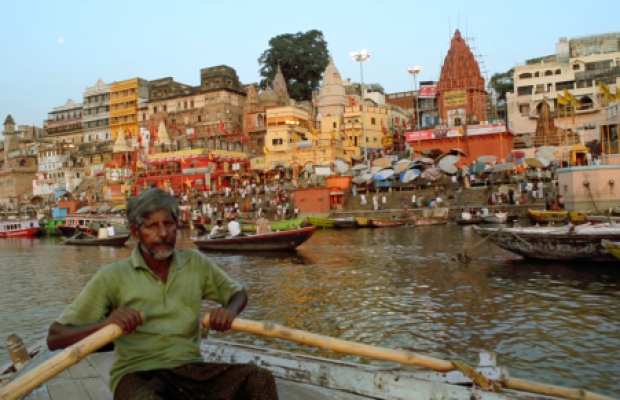
  3. There’s just something about the people that inhabit this world we call home, isn’t there?  This month’s “Faces in Places” intriguing winner, “Wise Man,” comes from a trip through Varanasi, India. The photographer, Monica, says this about the shot:

    Varanasi, being a very chaotic place, I was amazed by this man who was just sitting there against the great blue background reading. Don’ think he cared about me taking some pictures, more surprised why I was so interested.

    One look at this shot and all of us travelers are immediately drawn to wonder about him. Matt was filled with questions: “Is he a writer, a poet, a philosopher? What is he writing/thinking about? Why does he look so much like Allen Ginsberg?” Luke contemplated his future: “My goal is to live to be 111. I have big plans for what I already refer to as my ‘eccentric years.’ At 98, I was planning on sitting on a mountain as a ‘wise old man’ and having youngsters come to ask for advice.” Perhaps Maria had the most accurate critique: “you talkin’ to me?”

    Congratulations, Monica, your shot is TheExpeditioner’s “Faces in Places” June Travel Photography Contest Winner. To see more of Monica’s outstanding work, head over to her flickr photostream or check out her submissions to TheExpeditioner’s Flickr Photo Group.

    Check back soon for our post featuring the contest runners up. July’s contest theme . . . Urban Jungles! Reach deep into the bowels of those hardrives, get out your very best cityscapes from around the world, and upload away!


  4. The merits of travel to poorer areas of the world are constantly being debated. Some believe it helps communities, while others believe it helps to destroy them. However, as many travelers already know, there are ways that one can travel while conserving, and preserving, the area.

    The goal of Help Tourism, in India, is as the name says: Heritage, Environment, Livelihood, People. Its purpose is to encourage travel as “a tool for conservation and sustainable development.”

    When reading this recent article on Gonomad.com about Help Tourism, I felt what the experience of being a part of something different must be like. Dr. Swati Dasgupta joined the group to aid those still affected by Cyclone Aila’s aftermath, a storm that hit the Indian Ocean in May 2009. “The people of the delta are simple, stoical, bereft of the pettiness of urbanization. The inhospitable land has endowed them with values and a sense of hospitality that moves the outsider.”

    I can’t help but marvel at humanity’s grace. It’s as though by extending a hand, out of courtesy and respect, that fear and hostility are not even calculated into the equation. My friends call me optimistic when it comes to my outlook on humanity, but how could we not believe in the good when an example is right there on a page?

    Nevertheless, amidst the “wild beauty” of West Bengal, there is a dark side to watch out for. “The core forest area is forbidden territory to all but the forest department. At times misfortune strikes a fishing boat that has strayed into illegal waters. The stealthy tiger often climbs on such a boat and drags off a sleeping victim.”

    In other words, the people may be lovely, but the wildlife is hungry.

    That being said, conserva-tourism is obviously not for those who need the creatures of comfort. It is for those who seek a little spice and adventure, and even a few heart palpitations. I don’t think it’s easy to say which experience is better or worse, they are just different.


  5. I have always been hyper-organized, borderline dogmatic, and would get frustrated anytime things did not go according to plan. Even growing up, some people were proud to say they make full, three-second stops at stop signs. Actually, just today I was hollered at by a lady across the street as I glided through a four-way stop on my bicycle. I guess my standards of structure have changed.

    It wasn’t until I was 22, stepping off the plane in Taiwan’s International Airport, that I began to realize how “structured” a life I had been living. Sitting in the cab on the way to Hsin Chu — an hour west of Taipei — zooming in between and around vans, cars, motorcycles and scooters was a heart-stopping, yet mind-blowing moment: chaos can work.

    This was the realization highlighted in David Armstrong’s article in the San Francisco Chronicle. He ventured to Mumbai and caught a glimpse of the beauty in, what he refers to as, “orchestrated chaos”. (more…)


  6. This video’s got a great intro that reads:

    In January 2010 I traveled with a friend to Nepal and attempted to drive an auto rickshaw 2,000 miles to the bottom of India. The rickshaw broke down every day and eventually completely stopped working. We took the train the rest of the way.

    Is this why auto rickshaws are rarely used for long-distance travel? Or is it the fact that its top speed is around 30 mph. (Do the math, that means that 2,000-mile trip would’ve taken 66 days if they drove 24 hours a day with no breaks.)

    This trip was kind of destined to fail, wasn’t it? But kind of in a good way. A good way in the sense that whatever bar this guy’s in for the rest of his life, when the conversation lags, he can pipe up and say, “Did I ever tell you about the time I tried to drive across India in a rickshaw?”


  7. It was either Kierkegaard or Elvis Costello that once said, “Writing about music is like dancing about architecture — it’s a really stupid thing to want to do.”

    Perhaps the same could be said of writing about India, a country so vast and diverse that no words could do it justice. With that in mind, it almost makes more sense to describe the country though pictures, as acclaimed photographer Gabriel Herman did on her recent two-week trek to India, which included stops in Delhi, Agra, Jaipur, and Goa.

    By Gabriela Herman


    (more…)


  8. You know how you’re always thinking to yourself, “I wish this next trip I could both surf and expand my spirituality at an ashram”? Well look no further than that Kaliya Mardana Krishna Ashram in Karnataka, India, home to Swami Narasingha.

    As the Telegraph reports, “Swami Narasingha, who grew up surfing in Florida, established this coastal outpost to his main ashram four years ago. For the past two years they have welcomed paying guests, as well as sharing their surfing knowledge and love of the ocean with local children.”

    A glance at their site reveals that daily activities include “surfing, kayaking, swimming, volley ball, mantra meditation, yoga-asanas, surf film entertainment and environmental awareness documentary presentations.” Sound like most Sandals resorts, right?

    Rooms are 2,500 rupees a night for single occupancy (or about USD $55) and 3,500 four double occupancy (USD $76). Enlightenment is extra.


  9. Hump Day: My Camel Trek In India

    There are surely easier — and less smelly — ways to travel through Rajastan’s Thar Desert. But with a face like that, who could say “no” to a camel?

    By Lucy Corne

    As I bounced around in the camel cart trying to cling on to a bale of half-chewed hay, I was surprised to find myself thinking that I’d actually rather be riding one of these animals. Of course, being sandwiched between two camels, pondering which end emits a worse odor is not the most enviable position to be in, but I never thought I’d actually feel comfortable sitting atop a camel’s hump.

    Quite a step for someone who, just 24 hours earlier, actually burst into involuntary tears at the mere thought of even touching a camel. It was a series of mistakes and coincidences that had led us to Bikaner, a relatively quiet corner of India’s much-visited Rajasthan province. Unable to secure tickets to the prettier, more popular city of Jodhpur, we opted instead for an overnight train to Bikaner, an untidy town in the northern reaches of India’s Thar Desert. With plans to stay a night and then head north to the Himalayas, we asked a rickshaw driver to take us to the closest cheap hotel. Our lack of Hindi and clear status as backpackers led him to presume that we were here for an overnight camel trek — seemingly the only reason people detour to Bikaner — and drove us away from downtown to Vijay’s Guesthouse, home of the infamous “Camel Man.” (more…)


  10. India’s definitely one of those countries where its sheer magnitude is sometimes hard to get your head around. Take for example the fact that in 1947 the country was comprised of 565 princely states, most of which was home to their own extravagant palaces.

    What, you say, not content with shacking up in a hostel for your entire trip to the sub-continent? You’re in luck. Many of these estates have opened their doors and offer travelers the chance for a little royal treatment of their own (we can dream, right?). Beware, your budget must be able to withstand a hit of at least a few thousand dollars.

    There are a few exceptions. Take for example Udaipur’s Lake Palace in Rajasthan, where for about $400 a night you can shack up in one of the country’s most iconic buildings. (Remember how Anthony Bourdain boated out here in his India episode for a martini nightcap?)

    For something a little more landlocked, the nearby Umaid Bhawan Palace, the 26-acre, 347-room behemoth — said to be one of the  largest residences in the world — also doubles as a hotel for those willing to spend the $400 a night.

    For the rest of us nestled up in nearby hostels, many palaces are open to the public, like Agra Fort. Just northwest of the Taj Mahal, this UNESCO World Heritage site is only a few dollars to get in, and a great way to see what it was like to be a Mughal leader in the 16th century (the answer is: good).

    For some more ideas and places to ogle, click through here.


  11. vertigohotel

    New York to Delhi for $835 (total): I may harp on these flights to India, which is usually a sign that I’ll have trouble putting off my own trip there soon, but anytime you’re able to score flights there for under a grand you’ve got to seriously think hard about going. Valid until the end of the year.

    New York to Lima for $250 (total): This one’s valid for travel between May and June of 2010, just in time to blow your tax refund!

    The Coolest Idea For A Hotel Ever: Okay, this one’s not so much a deal as it is a total gimmick that I would definitely fall for: a “Vertigo” themed hotel in San Francisco. Not only was the building a shooting location, but the hotel works in nods to the film all over the place, from the spiral staircase to the swirly symbol found in the artwork. Rooms start from $119.


  12. hare krishna

    Just as America has it’s 9/11 which altered its future, India has it’s November, 2008. Unfortunately, the results of these events are a part of the times we currently live in. This post on IntelligentTravel is a sobering reminder of that.

    The article talks about the security measures instated at New Delhi’s ISKCON Hare Krishna Temple since the attacks in Mumbai. Just coming back from the ease and serenity of the temples in the Far East, it’s hard for me to picture a line of people waiting for a pat-down before entering a place of worship as if it’s a Packers game. Security at places frequented by locals and travelers is now a top priority. Although perhaps necessary, it is unfortunate.

    As the author waited at the security check, she overheard the most striking quote I’ve read in quite some time, “If God needs all this to protect him, how on Earth will he protect me?”


  13. diu

    I was only but a slowly developing zygote 30 years ago, but in the world of travel lore, Goa was the place to be around that magical time period during the 1970′s. Today? Not so much. But for the chance of experiencing your very own sense of discovery, try heading north to Diu.

    Not that you’re likely to run into too many hippies there today, but Diu, the small island lying just off the Gujarat coast, does offer the chance to visit a laid-back, un-commercialized island far from any tourists, as this Times article explores: ” . . . the beach, Nagoa, on which Indian men, tourists from the cities, frolicked delightedly in beige underwear. We were the only Westerners there.”


 feature articles 

Forget MALAYSIA


An ISRAEL


Travel TRAVEL FOOD


My THAILAND


5 TEACHING ABROAD


The COUCHSURFING

Online Hotel Reservations

Find and Book your Hotel!

More Destinations

 most popular today 
  1. How Many Americans Have A Passport?
  2. How Many Days Can I Travel In [Insert Country Here] With $1,000?
  3. Images of Ethiopia
  4. Top 7 Free Things To Do In New York City This Summer
  5. What's The Longest Nonstop Flight In The World?
  6. Top 5 Spots For Street Food In Paris
  7. The Top 5 Rules For CouchSurfing
  8. Fighting The Flashpacker Label (What Is A Flashpacker Anyway?)
  9. The Expeditioner’s “Animals Of The World” August Photography Contest Winner
  10. Luke’s Europe Trip: Dispatch #2 (Encounters With The Devil In Prague)

 most recent comments 
  1. Sabrina on Thursday, September 2, 2010 @ 3:28 pm: I only got to the one suggestion, but I am keeping the printout for future visits :) Saigon...
  2. Sabrina on Thursday, September 2, 2010 @ 3:26 pm: Totally a convert :) It will be one of my staples now whenever I go to Egypt!
  3. jonwick on Thursday, September 2, 2010 @ 9:08 am: What it really boils down to is traveling, right? How you travel is one thing, but simply...
  4. TheExpeditioner on Wednesday, September 1, 2010 @ 10:40 pm: Awesome, glad it was a good guide. Both of you are making me really jealous. I did a...
  5. TheExpeditioner on Wednesday, September 1, 2010 @ 10:38 pm: Yeah, I'm not big on labels myself. I've also heard the term...

 article archives 
Africa (9)
Asia/Pacific (25)
Europe (37)
North America (14)
South America (19)

 feature video 

season two
Southern Africa
TheExpeditioner Guide to Southern Africa
Montreal
TheExpeditioner Guide to Montréal
Dublin
TheExpeditioner Guide to Dublin, Ireland
season one
Colombia
Scandinavia
Argentina/Chile