



-
We would like to thank each and every one of our The Expeditioner readers for yet another great year in the world of travel! It’s always a great time to reflect on it all. Let’s see . . . Luke fell in love, Jon married his love, Brit returned home, Matt tackled SE Asia, we got correspondents at the Olympics and the World Cup, Maria joined us to offset the number of bearded writers, and the publishing of The Expeditioner’s Guide to the World — yeah, there’s a lot to be thankful for around these parts. Now only for those pesky New Year’s resolutions . . .
For our final installment of “The Expeditioner’s 2010 In Review,” our fearless leader drops some knowledge bombs we all should take note of: how to combat jet lag, the dethroning of Eat, Pray Love, and a possible explanation of how the American hikers were led off course in Iran. Capt’n Matt, you have the floor:
Where Did You Travel in 2010?
Montreal, Hong Kong, Vietnam, Cambodia, Japan (more…)
-
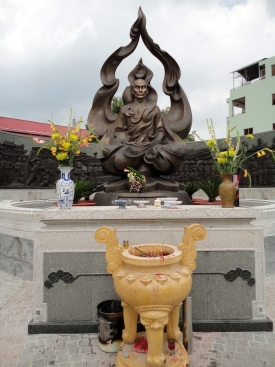
On June 11, 1963, Buddhist monk Thich Quang Duc set himself on fire to protest the treatment of monks by American-backed President Ngo Dinh Diem. This act led to the steep decline of the support of the President, and is widely believed to be the end of his reign, culminating in his assassination in November of 1963 with the backing of the Kennedy administration, and ushering in the beginning of even higher tensions in the country.
Today a poignant memorial stands at the intersection where his self-immolation occurred, another reminder around the city of the troubled history of the country. Incense is burned at the base of the statue, and candles are burned in honor of his sacrifice. (more…)
-
Jet lag does some strange things to the mind on the road. Waking up, sweating in the middle of the night, with no chance of falling back asleep, it sends your mind into some dark corners of the world, switching off all pleasure receptors and robbing you of all that you hold dear. But, alas, when the fog finally clears, the circadian rhythm jumps back in line, and the overhead sun no longer sends shivers down your spine when you step outside, the world comes back into focus, and you wonder what all the fuss was about.
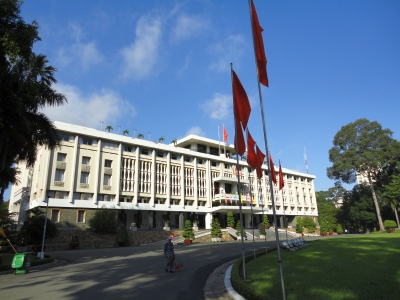
But a step back one day, wandering the streets of District 1 at 6:50 a.m., already awake for several hours, I grabbed a mid-morning snack, a banh mi from a corner food stand, and made my way to Reunification Palace, perhaps Saigon’s most well-known landmark. It was here on April 30, 1975, that — as the blasting soundtrack on the post-tour DVD explained — the Liberation Army rolled its tanks through the ornate front gate and finally ended decades of colonial rule. For those in the West, this was known as “The Fall of Saigon,” but for most in Vietnam, it was the beginning of the end of foreign occupation, and the building is an important historical sight no matter how you view those fateful days in 1975. (more…)
-
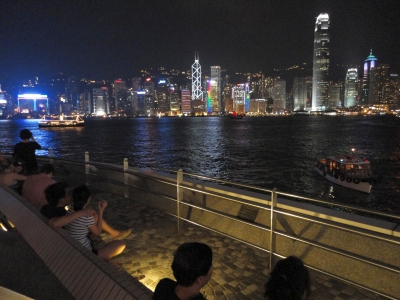
There are a couple of things you should keep in mind when planning to include a massive layover during your trip. One: despite its reputation, layovers are good. Especially when they’re in a city you’ve never been to before. Especially when it’s Saturday night. And especially when you have two weeks ahead of you to not worry about the consequences. And Two: Mind the jet lag, or what we in the medical profession refer to as “desynchronosis,” a disruption of the circadian rhythms that will cause irregular sleep patterns, shifts in mood, and the need to blog at 4:30 a.m. the next day after falling asleep around dinner time.
I wasn’t really sure what to expect from Hong Kong. Seeing as I was going to be there for roughly 12 hours, I kept my research and planning to a minimum, relying on the maxim that a little spontaneity goes a long way during travel. Given the city’s long history as a trading port, wits its deep harbor and strategic location, I somehow had this vision of a an old, colonial seaside port filled with salty merchants of the sea hawking fresh seafood and exotic goods from their travels. This is basically accurate, but substitute the sailors for Brooks Brothers-clad London Investment Bankers, and substitute the exotic goods for collateralized securities and designer handbags. (more…)
-

As synonymous with Vietnamese food as the country’s signature dish, pho, it turns out banh mi is actually quite a new invention for this very old culture. What, did you think the rice farmers along the Mekong Delta were munching on French baguettes back before the 19th century?
As the WSJ recently examined, the French — who, as you may not be too surprised to learn, often stuck to their own familiar cuisine, even when colonizing countries thousands of miles away — introduced the baguette into Vietnam during their occupation. The new loaves of bread were named banh tay (or “foreign cake”) by the locals and, due to their high price, were eaten only by the rich. Originally just bread, butter and ham or pâté — a very traditional Parisian sandwich — banh mi, as Andrea Nguyen in the NY Times explains, then went through a transformation. “Then, the Saigonese made things interesting.”
Driven by an urge to adapt local tastes to a foreign food, ingredients were added, ranging from cured and cooked pork, lemongrass chicken, egg, crushed pork meatballs, green herbs, sweet pickled vegetables, cilantro, and sliced chili peppers. Stuffed inside a sliced baguette with a healthy dose of mayonnaise, the sandwich enjoyed a renaissance during the ’80′s as Vietnam’s economy grew, finding its way into the streets of the cities as a to-go meal.
Fast forward a couple decades, and the sandwich started to catch on the U.S., with shops springing up around the country. Now, cities like New York and L.A. are brimming with Banh Mi options (here’s a list of 10 places for the best in New York and a list of the best in L.A.), each with their own take on the creation, from homemade baked baguettes to specially-sourced meats. For the best in Ho Chi Minh, try Concierge.com’s tip and head to the street vendor at 37 Nguyen Trai Street (in District 1) where, they promise, the peddler is guaranteed to turn you into a banh mi lover. As if you needed any convincing.
[image by Charles Haynes/Flickr]
-

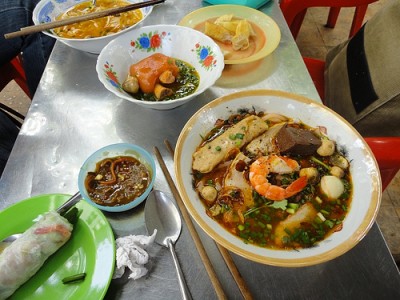
Meet Nguyen Thi Thanh, or better known in these parts as the “lunch lady.” Due to the relentless coverage of television (Bourdain visited her last year on No Reservations) and the blogosphere, Saigon’s own Nguyen Thi Thanh has become the David Chang of Ho Chi Minh, creating legions of foodie followers and elevating her little street corner stall to Momofuku-like stature with her rotating cast of soups, from Monday’s bun Thai to Sunday’s smorgasbord of bun thit nuong, bun nem nuong and bun cha gio. Today, a meal by the lunch lady is a required “to-do” for all visitors to Saigon.
Located near 23 Hoang Sa Street (down the alley on the right side), this little stall run by Thanh and her family is usually mobbed by patrons, and it is not unheard of for a line to form as she begins serving at 11:00 a.m. This is due to the fact that all her ingredients are bought fresh that morning from the market, and when she’s out of food she’s done for the day. As Gastronomy Blog reports (this is the blog that turned the world onto her), Thanh has kept her prices below 13,000 VND, despite rising costs, and refuses to raise them out of loyalty to the local workers who frequent her.
Eatdrinknbmerry.com was fortunate enough to visit Thanh on a Friday when she was serving up piping hot bowls of bun bo hue, made of a broth the color of “fiery red, a sign of dense chili sauce and probably annatto seeds,” and filled with beef and cha, or pork sausage patties. Topped off with congealed pork blood (huyet) and noodles, this soup has been known to make travelers, in just a matter of minutes, reconsider ever leaving. Something tells me, Thanh would be just fine with that.
-
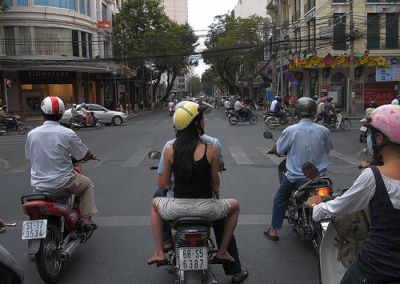
A tour of Saigon from the backseat of a motorcycle.
It’s dusk in Ho Chi Minh City — or Saigon as it is still called here — and the haze of the last ounce of light from the crimson setting sun is smothered in smog as I make my way through the busy streets. The thousands of motorcycles and scooters that clog the streets of Saigon every minute of the day begin turning on their headlights, lighting up the city in an iridescent glow of traffic.
I am on Pham Ngu Lao — essentially Saigon’s answer to Bangkok’s Khao San Road — in search of a place to sleep. It caters to the backpackers of Southern Vietnam, acting as a tourist information hub as well as a bus terminal. There are a wide variety of budget restaurants and trinket shops spread between dozens of ultra-discounted clothing retailers. However, a quick turn down one of the alleys off of the street reveals a much different world. These one-and-a-half-meter-wide thoroughfares shift through small neighborhoods of clustered homes with open doors, loud televisions, and even louder residents. There is an anthill of movement, babies crying, and the occasional chicken making its way across the street. The stir of Mahjong chips and smiles sets a jovial atmosphere to the otherwise intangible background static of the labyrinthine cement corridors.
When the hotels along the city’s main strips of Bui Vien and Pham Ngu Lao Street fill up during the peak season, travelers often wander down these dovetailed back alleys to find a host of inviting open doors with hand-painted hotel signs. Many of them are nothing more than a family’s home where spare bedrooms are rented out for extra money when the impending tourist boom busts at the seams. (more…)
-
Bánh xèo means either “sizzling cake” or “sound crepe,” depending on what your Google search turns up, but either way, the name refers to this southern Vietnamese crepe made of rice flour, water, coconut milk, pork, shrimp, and bean sprouts that’s pan fried, then “rolled up in a leaf of lettuce and dipped in a flavorful lime-scented sauce before it gets popped in your mouth.”
The above vid, shot in the streets of Ho Chi Minh City, shows you the best way to make it. Volunteers who would like to experiment creating this dish are welcome to my house anytime.
-

Travel to Vietnam has been exploding during the last few years, with over 4,000,000 international travelers in 2007 alone (a 268% increase from 1998), and it’s probably fair to say that the Vietnam’s well-deserved reputation for food has helped drive this surge.
Far more the pho, Vietnam’s busting at the seams with restaurants serving muc nuong muo ot (grilled squid served with chilies and salt), oc nhoi thit (snail shells stuffed with minced pork and lemongrass), and bun thit nuong (grilled minced pork served with fresh basil and mint, shredded cucumber and carrot, bits of lettuce, and chopped peanuts).
Here’s a few suggestions when in Saigon for where to try some of the best of the above, one of the coolest sounding places being Quan An Ngon, a restaurant that recreates the chaotic and eclectic vibe of the food market, and featuring some 19 separate stalls, each providing their own in-house live cooking show for the diner.
Did I mention that entrees in Vietnam average around USD$3? Yeah, that may also help to explain it’s popularity.
Click here for the book's website and to read an excerpt!
 NEW YORK CITY
Cheap Paris Hotels, Cheap London Hotels,
Cheap New York Hotels
 THE PHILIPPINES
 NEW YORK CITY
 SPAIN
SPAIN MEXICO
Online Hotel Reservations

Find and Book your Hotel!
- Hotels in Amsterdam
- Hotels in Venice
- Hotels in Rome
- Hotels in Paris
- How Many Americans Have A Passport?
- The Top 5 Rules For CouchSurfing
- How Many Days Can I Travel In [Insert Country Here] With $1,000?
- What's The Longest Nonstop Flight In The World?
- Top 5 Spots For Street Food In Paris
- A Night Out In Paris's Underground Dining Scene
- We Like "Stuff Expat Aid Workers Like" And You Will Too
- What You Need To Know About Couchsurfing
- An Ode To Poutine (What Is Poutine Anyway?)
- Top 5 Places To Eat In St. Clair West, Toronto
- Will on Thursday, January 13, 2011 @ 11:55 am: Sometimes you want to walk alone along the street of a lush Thai village. Sometimes you want to...
-
 wafMareaged on Thursday, January 13, 2011 @ 10:24 am: подскажите в каком разделе оставляют пожелания для форума?
 - @ConfusedJulia on Wednesday, January 12, 2011 @ 4:54 pm: Really useful article as I've been considering couchsurfing myself but was worried...
-
 Brit Weaver on Wednesday, January 12, 2011 @ 1:39 pm: Absolutely.
 - Jeffrey on Wednesday, January 12, 2011 @ 12:38 pm: Wow Matt…your cup will always be "HALF EMPTY". Now that you have gone into why...
Asia/Pacific (27)
Europe (42)
North America (17)
South America (20)
season two
Southern Africa

Montreal

Dublin

season one
Colombia
Scandinavia
Argentina/Chile
ABC News
AU Sydney Morning Herald
AU The Australian
Boston Globe
CNN
Chicago Sun-Times
Chicago Tribune
Financial Times
JP The Japan Times
LA Times
MSNBC
Montreal Gazette
NZ The Herald
New York Daily News
New York Times
Newsday
St. Petersburg Times
San Francisco Chronicle
Toronto Star
The Travel Channel
UK The Guardian
UK The Independent
UK Telegraph
USA Today
Wall Street Journal
Washington Post
Yahoo Travel
ZA The Independent
AmericanWay
Budget Travel
Business Traveller
Condé Naste Traveller
Forbes Traveler
Hemispheres
National Geographic Traveler
Outside Magazine
Travel + Leisure
Smithsonian
BootsnAll
CheapOair Travel Blog
Concierge
Gadling
GoMad Nomad
GoNomad
Jaunted
Kathika
Literary Traveler
The Lost Girls
Matador Trips
Matador Television
On Our Own Path
Travelmag
TripFilms
Vagabondish
What's In Your Bag?
World Hum
YouTube Travel

Home | About Us | Submissions | Twitter
Copyright © 2025 The Expeditioner, LLC
The Expeditioner Network | The Expeditioner | What's In Your Bag?
