



-
It’s funny, but a look over at that handy sidebar widget thingy on the right side of the site shows the most popular stories of the day (as determined by clicks), and one that keeps popping up there was one of our recent posts on which countries you can travel the longest through the longest on a modest budget. Which brings me some comfort: turns out, the rest of the (or at least those who read this site), are just as cheap as me. (Or another way to put it: the less I spend on a trip, the sooner I can do it again.)
Which is why I direct you to Lonely Planet’s post on some of the best countries in the world that can still be traveled cheap. Understandably, many Asian countries crop up on their list, including Laos, Nepal, India and Indonesia.
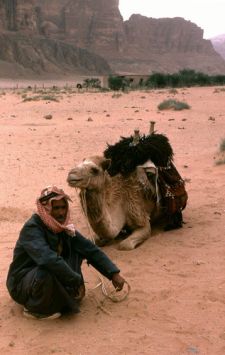
What I think is more interesting is some of their picks that many budget (that sounds better than cheap now doesn’t it?) travelers may want to take a look at. Jordan, for example, where rooms run$5 a night, and meals are likely not to run over $3. Combine that with ancient ruins and amazing sights and you’re already checking flights online. Other suggestions include Honduras, Poland, Morocco (away from the touristy sections), Sudan and Iran where you can expect to “see the wonders of the ancient world without a tour group in sight” (all for only $25 a day).
[image by Peter Ward/Flickr]
-
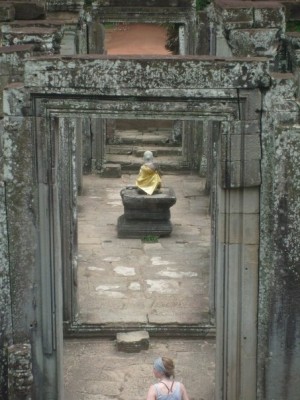
As a first time solo female traveler, you may feel fear. Sometimes, it’s as though the world we live in can be a bubble, trying to tell us of the things we shouldn’t be doing instead of encouraging us to get out there and experience it for ourselves. We are bombarded with “be carefuls” and “watch outs” instead of “keep your heads up and minds open.”
It was a relief to read this recent article at BootsnAll about a solo female traveler debunking those myths on her own. For six months, she traveled around foreign places — not hindered by being travel buddy-less — recommending that people use common sense and instinct as opposed to sticking to manuals. Her adventures remind me of Paul Theroux- although male — who is a self-proclaimed solo traveler. He wants the opportunity to explore things on his own for an opportunity to reach into a much-needed space of solitude and reflection — also, not wanting to bring his wife and kids into the potential dangers of where the wandering mind and soles can go.
Still, traveling alone may not be for everyone, no matter your gender. Some people like to share the experiences with others, even though others prefer the adventure that a solo sojourn can bring. It’s interesting how personal the stories differ when sharing them with others or doing them on your own. For some solo travelers, you keep the experiences for yourself, like little pieces of a personal garden you have grown.
-

Just like our itineraries are different, so are our levels of comfort. Some people prefer to bring the bare necessities, needing to pack light for their meandering feet, while others need to bring a personalized blanket for sentimental coziness. A recent article in The Toronto Star highlighted the importance of “packing a bit of home to cushion the road.” In it, Josh Noel provides some examples of what you can load up on to lighten your mood: An electric toothbrush, your own alarm clock, and framed family photos, just to name a few.
These items might seem a bit much, and I think they are — as the article was directed towards the business traveler audience — but his advice makes sense. For whatever reason that compels us to travel — either our company we work for or some innate desire — it helps when you have a tangible reminder of home with you. (more…)
-

Let’s face it, we travelers put up with a lot of aggravation on the road: lost baggage, missing passports, loud hostels, etc. . . . And we see a lot of things that bother us around the world: obnoxious tourists, environmental degradation, the plight of the world’s poor. But there’s one thing that annoys us the most, and which is constantly on our minds. Yes, I’m talking about your underwear. How many times have you, midway through your trip, with nary a laundry machine to be had, thought to yourself, “I wish I didn’t have to change my underwear so darn often!”
Well, you are in luck, for our nation’s best and brightest scientists, chemical engineers, microbiologists, and PHD-toting eggheads have put aside some time (finally!) from their — let’s face it, kind of fruitless — endeavors such as finding a cure for HIV/AIDS, solving economic disparity, and addressing climate change, and finally tackled that age-old world issue: the irritation of changing your underwear.
I introduce to you the Give-N-Go underwear from ExOficio: the world’s first underwear that does not need to be washed (very often). To you, the intrepid traveler, who asks, “Why do I need to change my underwear so often?”, ExOficio says, “Don’t!” (more…)
-
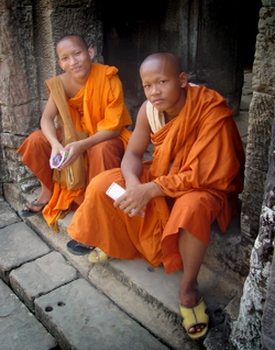
So you’re going to Cambodia (actually, I am in about 6 weeks, but more on that later), and once you get there all you really want to do is sunbathe nude while pointing the bottom of your feet at people as they walk by, and sticking you chopsticks upright in your rice bowl. Sounds like a pretty rockin’ good time, right? Well, actually, these are just a few no-no’s you should probably know about before traveling through the country.
As this how-to guide from Lonely Planet describes, there are about 10 rules that if you remember, you’ll probably go a long way in not instigating an international incident. Oh yeah, and all you women that want to touch some monks while picking your uncovered teeth with your shoes off in their temple. Sorry, Cambodia’s just not the place for you.
[Photo via Stock.xchng]
-
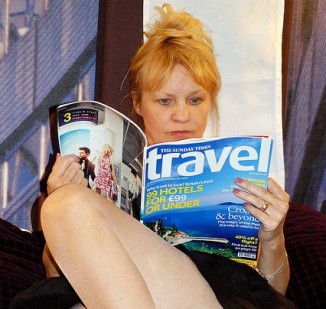
We were all travel virgins once. Not quite the — awkward lying next to each other, not knowing where to look, thinking of something romantic to whisper in your ear — kind of travel virgin. More like the — guide books awkwardly lying on top of each other, not knowing what to pack — kind. Even for the most well-seasoned world rompers, that first big trip is one that no one forgets.
For me, I was 19 years old, I had arrived in Germany, my luggage for this ten-day trip to Denmark and Sweden was far more than I could handle alone, everyone was wearing strangely tight jeans, and all I wanted to do was find the family friends I was to meet. I was abroad, on the other side of the planet, and I was still alive.
I ended up finding my friends — two brothers that studied in America when I was a toddler — and we were off to Denmark. The next ten days was a fairy tale, and it stoked a fire in me that has since taken me throughout the world. Taking that first step wasn’t easy- we all remember this, despite how suave a traveler we want to come across as - and I can understand how taking that first leap into travel could be intimidating for a first-timer.
-

Traveling solo can be daunting and, often times, exhausting. It pushes you mentally, emotionally and physically. Not only can you have a cerebral malfunction due to a cultural overload, but you have to learn to do things by yourself.
However, it is through traveling alone that one can experience a personal shift, a new-found independence, a sense of growth. In the end, on the whole, your spirit does not suffer.
In groups, each person is (usually) assigned a task in order to get things done harmoniously. The savvy Mappist, good with direction; the outgoing Communicator, possessing an aptitude in multiple languages; the Mom/Dad, keeping the kids in check. If you are fortunate, each individual contributes to the whole, providing a well-rounded, memorable experience.
The pain of being a solitary traveler is the necessity to perform all the above tasks on your own. At times, you may want to throw your arms to the sky, begging to be bestowed with ruby-red slippers.
This morning, reading Bootsnall’s list of 12 coping mechanisms for those traveling alone, I reflected on my days of solitude in Buenos Aires. I had traveled with friends, we rented an apartment together, but I had created a mental space of solitude. Everything was new and challenging. I wanted to do things on my own. (more…)
-

Seven months ago, we had arrived in Buenos Aires, on schedule, from Toronto’s Pearson International Airport. There were three-and-a-half of us — the half person was Benito, my friends’ cat — exhausted from the plane ride, but eager to meet Katrine, the lady who was supposed to pick us up and bring us to a pre-arranged downtown apartment.
We sat, we waited, we called (over and over), we desperately wanted showers and a siesta, and a spot where Benito could spread his legs. Katrine never came.
Tired and frustrated, we made the consensus to just take a cab to a hotel. We ordered a cab, packed it to the brim with our luggage and selves and asked the driver if he could take us to a hotel. He drove us to a small, “rustic” hotel just off the beaten path in Congreso, where we checked-in as three guests, smuggling the small furry half-person in. (more…)
-
It’s been over a week since I arrived back here in North America, switching hemispheres, jumping from Fall to Spring - yet again. I’m sure most, if not all, can relate when I say it’s been surreal.
Even when reading Jon’s post on the PTF (Post-Trip Funk), I kept saying to myself: “that could never happen to me.” Well, it did, and with a great force. I think that my somewhat-recovery after just a week is pretty good. Nevertheless, there are some observations and recommendations, the quirky and the practical, that I would like to share with globetrotters everywhere. (more…)
-
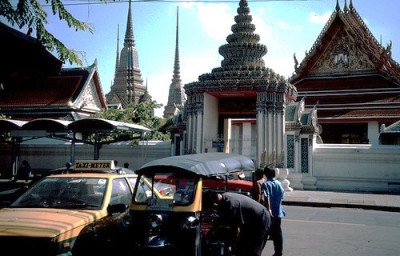
Oh, Bangkok. What will we ever do with you? Some love it, some hate it, some have both feelings towards it — often at the same time. It grabs travelers for indefinite amounts of time when they were simply passing through. It’s conflicted, it’s beautiful, it’s Bangkok, and we wouldn’t have it any other way. The complex culture and contradictions pose some obstacles for the millions who travel there, so when I found a post on some tips to Thailand, over at thrillingheroics, I took notice. It’s written by an expat, self described as being “marooned” there:
It’s a developed metropolis in the middle of the developing world where ancient tradition meets cutting edge technology. Bald-headed, orange-robed Buddhist monks wander the streets toting the latest iPhones; gray-haired Alabama exports sport handlebar mustaches and transgendered girlfriends. You will see the Old juxtaposed with the New, the East juxtaposed with the West. Thailand feels a bit like the Wild West meets The Fifth Element. I came to Thailand in 2008 after a bad breakup (two actually), quitting my office job, and many months of stagnation and boredom with my suburban existence in the States. I wanted to live for a year abroad, somewhere as different as I could possibly find. I wanted to create a location-independent lifestyle, free up more time to read, learn, travel, and work on personal projects, test my self-reliance, expand my understanding of other cultures, and of course lounge on the beach.
I can remember having a ridiculous amount of questions before I boarded my first plane to Asia. Luckily, this post covers a wide range of topics that may trip up a first timer. It’s loaded with tips, from when to go (Oct. to Apr. to avoid the monsoon season), which cheap airlines to use (AirAsia, Tiger, and Nok Air… avoid Jetstar), to the legendary Thai food (go street stall), and the numerous scams you should be aware of (NEVER get in a taxi that doesn’t have the meter on).
Despite all the intimidating madness, riots, and scams, the author’s voice never turned negative (which could have happened). I mean, how often have you seen monks standing on the same street corner as prostitutes? In fact, the craziness may just be what us travelers have come to expect, what we want, and what we need to discover by traveling there.
“Bangkok almost feels like it’s experiencing a bit of a renaissance right now — there are a lot of creeps in this town, but there are also innumerable creative types out here trying to make the world a better place.”
Perhaps Bangkok may have it figured out more than we will ever know.
-

Originally, I had wanted to come up with a list of the top-five touristy and non-touristy things to do in Buenos Aires and then I realized that: a) that would be a little righteous as everyone´s experience is going to, and should, be different, b) unless you move here indefinitely or are born here, you are going to be a tourist, and c) it´s o.k. to be a tourist. After 6 months, I am no porteña. Still Canadian, thus a tourist.
However, I understand the frustration that some may have when trying to take a picture of some beautiful architecture and the photo is ruined by a sea of sun-hats and people you don´t know. So, at the end of this amazing trip, I decided to share some spots around Buenos Aires that are worth experiencing. Obviously there are always going to be tourists but, perhaps, those kind of tourists that are doing exactly what you plan to be doing: getting to know this amazing city.
Everyday that I was here I thanked my lucky stars to have had an extended stay. But, if someone could only do 5 major things in Buenos Aires, these are my recommendations: (more…)
-

Just when you think that your city is somewhat unique and interesting, you read an article that makes your head explode. Cities with underground offices, street dogs that can navigate the underground transit system, and a British-themed residential neighborhood on the outskirts of Shanghai are just a few of the “10 Weirdest Urban Ecosystems On Earth”, an article posted on io9.com, a new favorite site that keeps me updated on random - yet useful, especially in conversations with strangers — bits of information.
For example, when sitting at a bar in downtown-wherever you can lower your voice, look around skittishly and ask: Did you know that Centralia, a small-town in Pennsylvania, is rumored to have been the setting for the Silent Hill video game? Apparently, years ago, some guys set fire to some garbage near an underground bed of coal which caught and has overheated the town ever since (and it’s estimated to do so for another 250 years). The town was evacuated, yet some families still live there. Pretty interesting.
The Gowanus Canal, Brooklyn, New York. “[O]ne of the most foulest places on Earth,”, yet a hotbed — quite literally — for scientific research. From the depths of the deplorable dark-goo arises the possibility of a cure for diseases. According to the article, life actual can exist in the Canal. Little organisms have “found a way” by producing a type of antibiotic to combat bacteria and viruses. If harnessed, this proto-antibiotic could be a medical breakthrough. Take that Manhattan!
Not only is this article absolutely fascinating, but a good resource for the imagination. If you are a story writer, or teller, all of these cities have some serious potential for imaginative creation. Or, if you are just looking for some bizarre places to visit, add any of the urban ecosystems to your bucket-list.
*The above photo is of Japan’s ghost-island, Gunkanjima
-

Street food is always going to be a reflection of a city’s true culture. Not only does it give you a glimpse into a local’s diet, but the vendors offer an amazing ambience as well, even the crusty ones. For example, Torontonians and New Yorkers thrive on “street meat” — in Toronto it has been our only street food option for many years due to ridiculous municipal “sanitation” regulations (at least New York has honey-roasted peanuts). Nevertheless, both cities share street meat as one of the most popular eats whether it is midday or post-bar because: 1) the sausages are massive, 2) the vendors are everywhere, and 3) they are so cheap!
Whether it is a skewer of grilled chicken hearts or bowls of chick pea soup, everyone is intrigued and willing to try street food, no matter where they are. So, an article on WorldHum put together the top eight places to get street food and I was not surprised to see which cities made the list. The most obvious winners — like Mexico City and Marrakech — are internationally known as urban hubs of nibble and spice. Some of the cities garnerred a spot on the list because of the ambience of the market and/or the variety of options. Whatever the reason, I wore a bib whilst reading the article. The food that stood out the most to me (that I haven’t already tried):
1) simit - Turkish donut rolled around in sesame seeds found in Istanbul, usually eaten for breakfast with a thick cup of Turkish coffee.
2) harira soup - A Marrakech mixture of chickpeas, tomatoes, onion, cilantro, and tumeric. Everything that is great and good in the world of food.
3) seafood orgy - In Stone Town, Zanzibar, they have all-the-seafood-you-can-eat options. This means higher quality and fresher fish as opposed to the typical “all-you-can-eats” found in North America, which I’m pretty sure are on a rapid decline.
To be honest, I think every city holds a special place on the “street food list,” even if the quality cannot compare to fresh octupus in Palermo, Italy. There is something so comforting about snacking on tacos al pastor on a corner with locals in Mexico City. There is something so exhilirating buying an empanada de carne from a guy on a bike with an overly large front-basket in Buenos Aires. Not to mention, it also supports the local vendors.
 SPAIN
SPAINHaving troubles planning a trip?
Book cheap hotels, flights and car hire on one site.
Cheap Paris Hotels, Cheap London Hotels, Cheap New York Hotels
 MEXICO
Online Hotel Reservations

Find and Book your Hotel!
- Hotels in Amsterdam
- Hotels in Venice
- Hotels in Rome
- Hotels in Paris
- How Many Days Can I Travel In [Insert Country Here] With $1,000?
- How Many Americans Have A Passport?
- You Are Invited To The Expeditioner Book Release Party/Reading
- "World Festivals" November Photo Contest Winner: A Carnival Starlet
- What You Need To Know About Couchsurfing
- What's The Longest Nonstop Flight In The World?
- The Conquest Of Tarifa, Spain
- Top 10 Free Things To Do In New York City This December
- Top 5 Spots For Street Food In Paris
- Wednesday Travel Deals (Ski Edition)
- mr. bob on Wednesday, December 1, 2010 @ 6:05 pm: Right on Aaron! Who needs it. USA! USA! You ignorant, shallow, incurious troglodyte. Let me...
- Hal Amen on Wednesday, December 1, 2010 @ 5:15 pm: Nice! Congrats, guys!!
-
 brokenrecordbaby on Wednesday, December 1, 2010 @ 7:40 am: this post tickled me!
 - Norbert on Tuesday, November 30, 2010 @ 7:14 pm: Love the historical background of Tarifa; so interesting.
- adventureswben on Tuesday, November 30, 2010 @ 4:49 pm: Great primer to Tarifa.
Asia/Pacific (26)
Europe (42)
North America (16)
South America (20)
season two
Southern Africa

Montreal

Dublin

season one
Colombia
Scandinavia
Argentina/Chile
ABC News
AU Sydney Morning Herald
AU The Australian
Boston Globe
CNN
Chicago Sun-Times
Chicago Tribune
Financial Times
JP The Japan Times
LA Times
MSNBC
Montreal Gazette
NZ The Herald
New York Daily News
New York Times
Newsday
St. Petersburg Times
San Francisco Chronicle
Toronto Star
The Travel Channel
UK The Guardian
UK The Independent
UK Telegraph
USA Today
Wall Street Journal
Washington Post
Yahoo Travel
ZA The Independent
AmericanWay
Budget Travel
Business Traveller
Condé Naste Traveller
Forbes Traveler
Hemispheres
National Geographic Traveler
Outside Magazine
Travel + Leisure
Smithsonian
BootsnAll
CheapOair Travel Blog
Concierge
Gadling
GoMad Nomad
GoNomad
Jaunted
Kathika
Literary Traveler
The Lost Girls
Matador Trips
Matador Television
On Our Own Path
Travelmag
TripFilms
Vagabondish
What's In Your Bag?
World Hum
YouTube Travel

Home | About Us | Submissions | Twitter
Copyright © 2025 The Expeditioner, LLC
The Expeditioner Network | The Expeditioner | What's In Your Bag?
